The Story
Proton D540
Stereo Integrated Amplifier ( 1980 )
Description
The Proton D540 is a high current integrated amplifier which has been carefully developed with complete emphasis on the quality of sound.
Whether adding to an existing audio or video system, or as part of an all new system, you are certain to notice the clarity, detail and depth of performance which make Proton products among the best in the world, regardless of price.
Specifications
Power output: 40 watts per channel into 8Ω (stereo)
Frequency response: 20Hz to 20kHz
Total harmonic distortion: 0.02%
Damping factor: 90
Input sensitivity: 0.2mV (MC), 2.5mV (MM), 150mV (line)
Signal to noise ratio: 75dB (MC), 92dB (MM), 105dB (line)
Dimensions: 420 x 87 x 320mm
Weight: 8.7kg
Proton D540 Integrated Amplifier Review

Details & Craftsmanship
Every detail has been carefully considered to bring you the perfect product.

Details & Craftsmanship
Every detail has been carefully considered to bring you the perfect product.

Details & Craftsmanship
Every detail has been carefully considered to bring you the perfect product.

Details & Craftsmanship
Every detail has been carefully considered to bring you the perfect product.

Details & Craftsmanship
Every detail has been carefully considered to bring you the perfect product.

Details & Craftsmanship
Every detail has been carefully considered to bring you the perfect product.

Details & Craftsmanship
Every detail has been carefully considered to bring you the perfect product.

Details & Craftsmanship
Every detail has been carefully considered to bring you the perfect product.

Details & Craftsmanship
Every detail has been carefully considered to bring you the perfect product.

Details & Craftsmanship
Every detail has been carefully considered to bring you the perfect product.

Details & Craftsmanship
Every detail has been carefully considered to bring you the perfect product.

Details & Craftsmanship
Every detail has been carefully considered to bring you the perfect product.

Details & Craftsmanship
Every detail has been carefully considered to bring you the perfect product.

Details & Craftsmanship
Every detail has been carefully considered to bring you the perfect product.

Details & Craftsmanship
Every detail has been carefully considered to bring you the perfect product.

Details & Craftsmanship
Every detail has been carefully considered to bring you the perfect product.

Details & Craftsmanship
Every detail has been carefully considered to bring you the perfect product.

Details & Craftsmanship
Every detail has been carefully considered to bring you the perfect product.

Details & Craftsmanship
Every detail has been carefully considered to bring you the perfect product.

Details & Craftsmanship
Every detail has been carefully considered to bring you the perfect product.
Description
Proton D540
Stereo Integrated Amplifier ( 1980 )
Description
The Proton D540 is a high current integrated amplifier which has been carefully developed with complete emphasis on the quality of sound.
Whether adding to an existing audio or video system, or as part of an all new system, you are certain to notice the clarity, detail and depth of performance which make Proton products among the best in the world, regardless of price.
Specifications
Power output: 40 watts per channel into 8Ω (stereo)
Frequency response: 20Hz to 20kHz
Total harmonic distortion: 0.02%
Damping factor: 90
Input sensitivity: 0.2mV (MC), 2.5mV (MM), 150mV (line)
Signal to noise ratio: 75dB (MC), 92dB (MM), 105dB (line)
Dimensions: 420 x 87 x 320mm
Weight: 8.7kg
Proton D540 Integrated Amplifier Review
Amplifier designers have long recognized the significance and desirability of a high short-term reserve power capability; it is the basis for the dynamic-headroom specification. But Proton’s research suggested that the standard EIA 20-millisecond dynamic-headroom tone-burst test signal was unrealistically short in view of the peak-power demands of real-world music signals. Although the maximum amplitudes might last only 20 milliseconds or so, many waveforms decay over a much longer time period and thus could require an amplifier to deliver much more than its rated continuous power for as long as several hundred milliseconds.
To meet this requirement, Proton developed a Dynamic Power on Demand (DPD) system, used in the D540 integrated amplifier, that allows an amplifier’s maximum unclipped output to exceed its continuous-power rating by four times (a 6-dB increase) for considerably more than 20 milliseconds and to decay slowly over a relatively long period before returning to the maximum steady-state output level. While the same capability could have been achieved by several conventional design approaches, another requirement for Proton’s designs was that the amplifier be highly efficient and moderately priced.
The D540 is a relatively low-powered amplifier whose output transistors normally operate from a low-voltage power supply although they are capable of much higher power levels. There is also, however, a second, high-voltage supply, together with a power-control circuit that monitors the instantaneous output level from the amplifier. When the D540’s output power reaches an internally set threshold level (which is close to the amplifier’s continuous-power capability), fast-acting electronic switches connect the high-voltage power supply to the output transistors, increasing their maximum power capability to several times its normal value. Because the high-voltage supply is used infrequently and only for short periods of time, its continuous current rating can be very low. In fact, it merely charges up the capacitors to its full voltage, and when more power is needed the amplifier draws it from those capacitors.
Proton’s DPD system calls for storage capacitors large enough that a high short-term power level can be sustained for 200 to 400 milliseconds, after which it gradually declines. If a continuous tone is applied at the highest signal level, the DPD power reserve decreases until the internal switches disconnect it, leaving the amplifier to operate at its rated continuous-power level while the capacitors recharge (which takes about a second). Because the switching occurs at close to the amplifier’s normal full-power level, any switching transients are masked by the program content. And since the power transistors operate at a fraction of their capability under normal conditions, they cannot overheat and therefore require no current limiting or thermal protection systems.
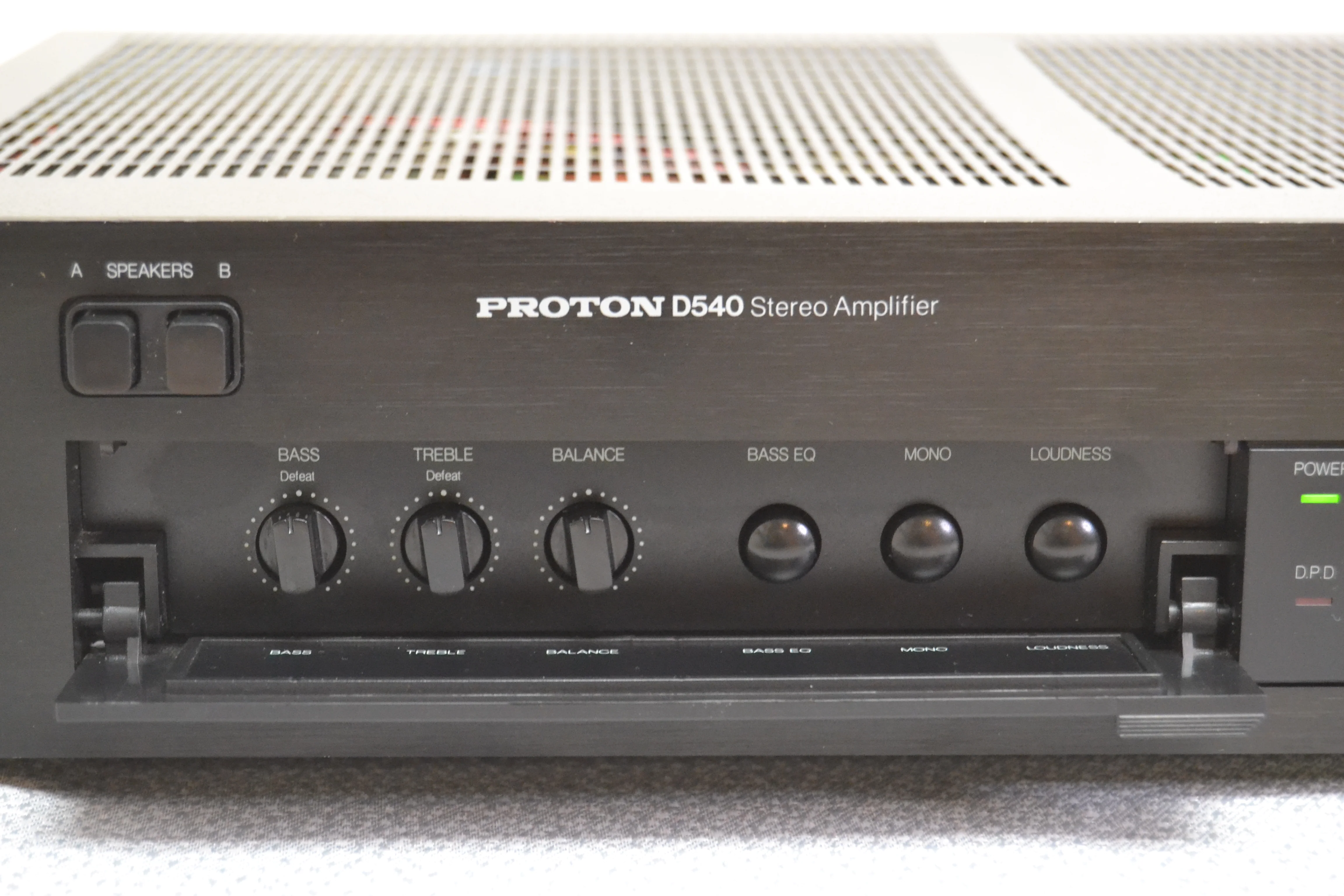
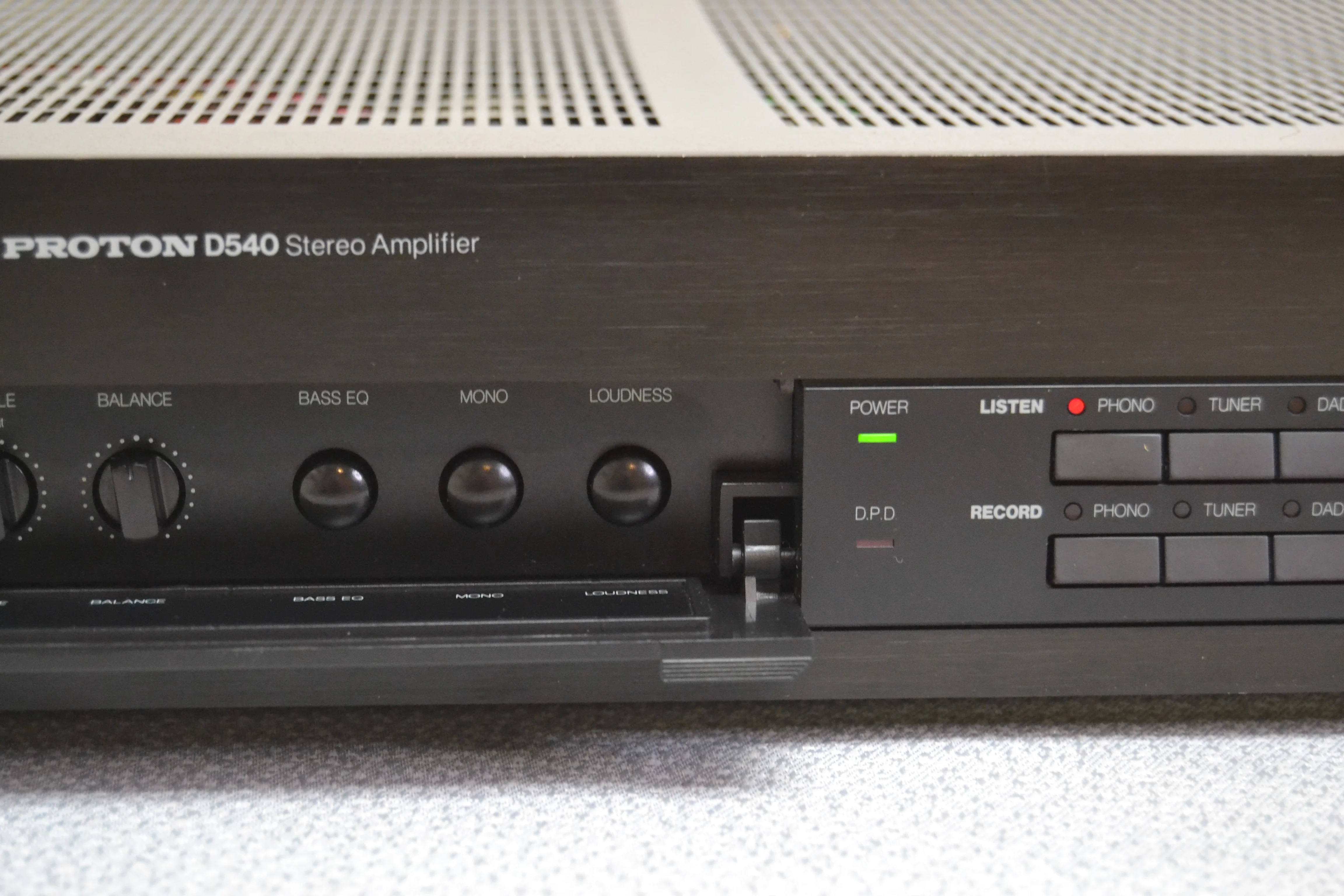
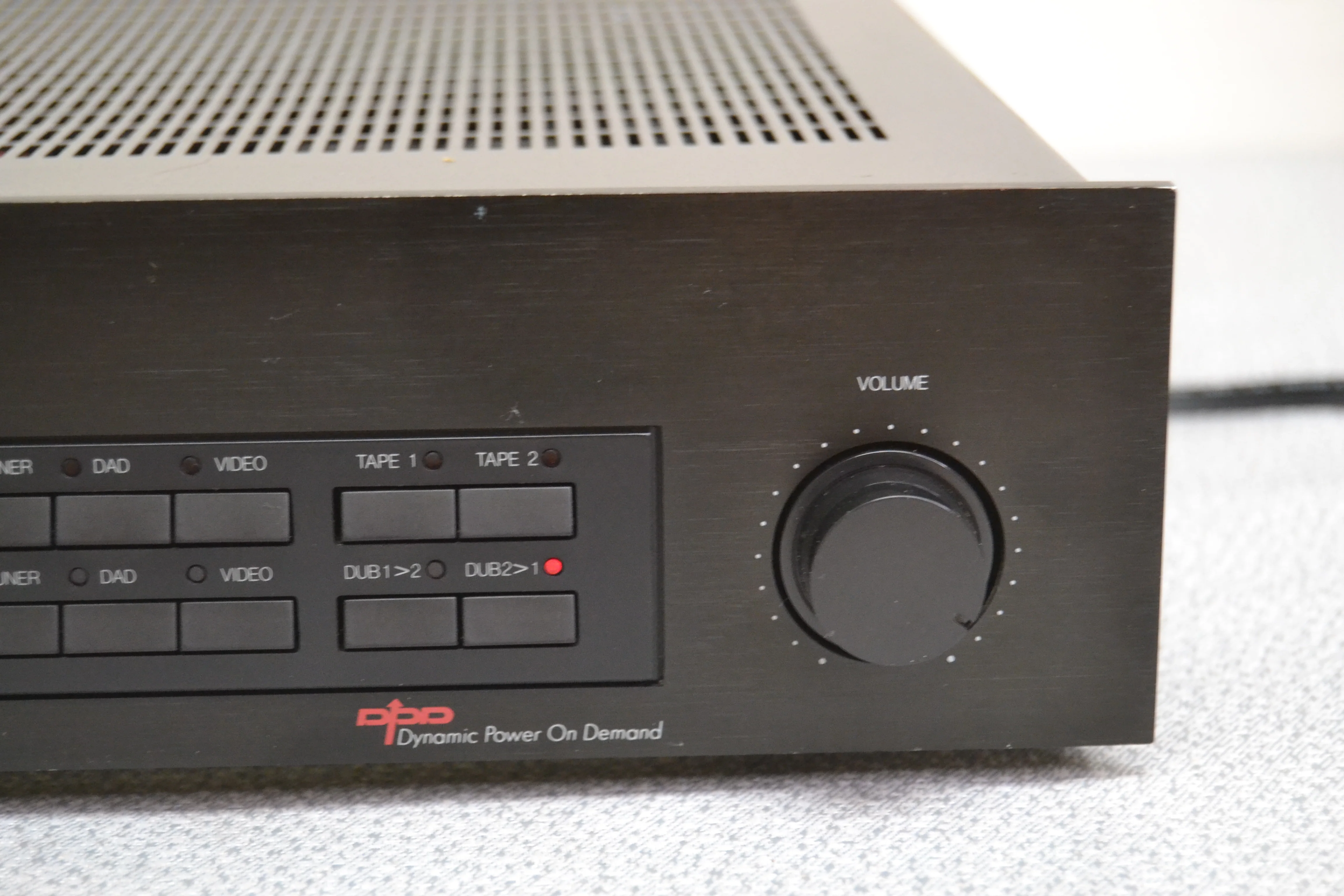
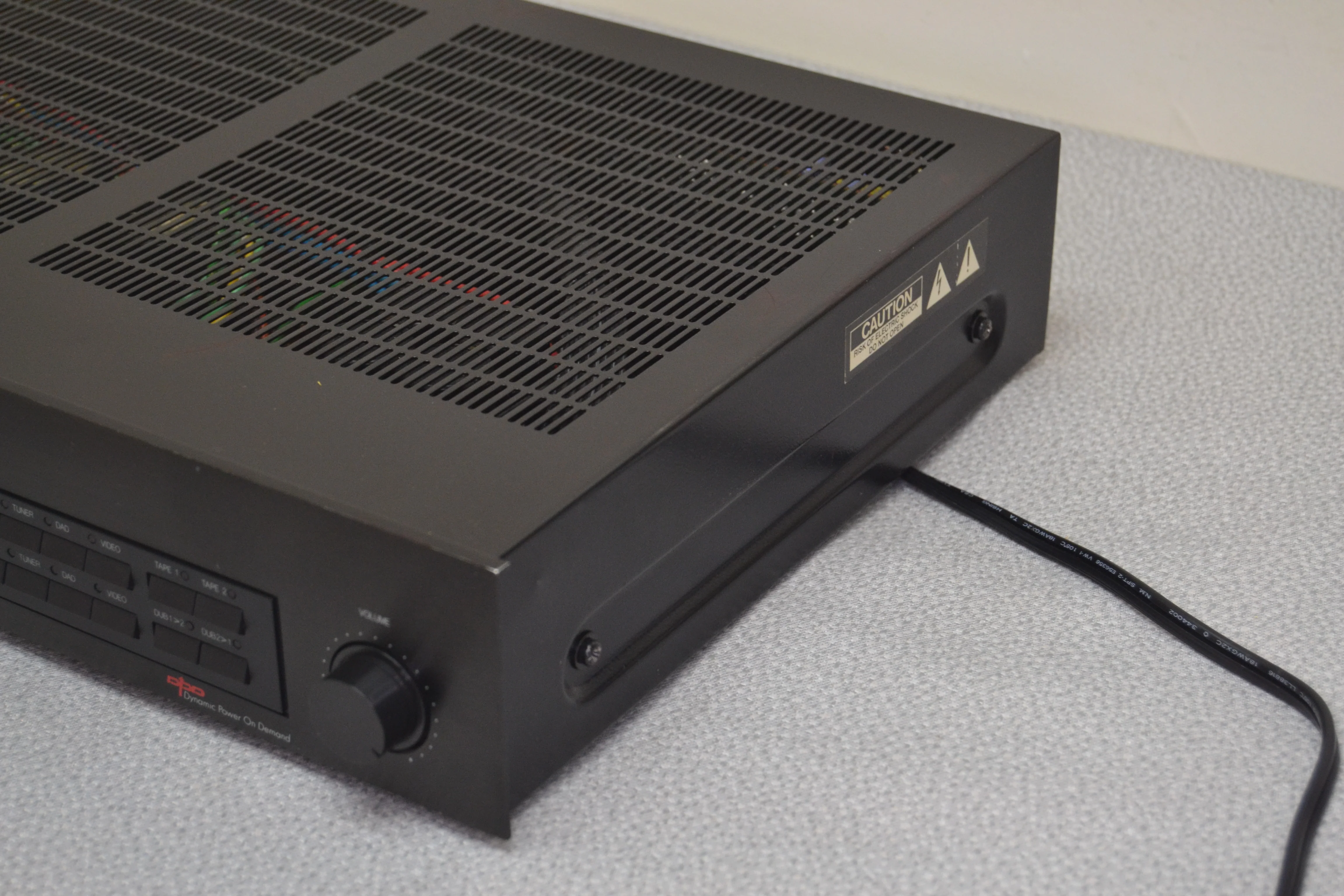
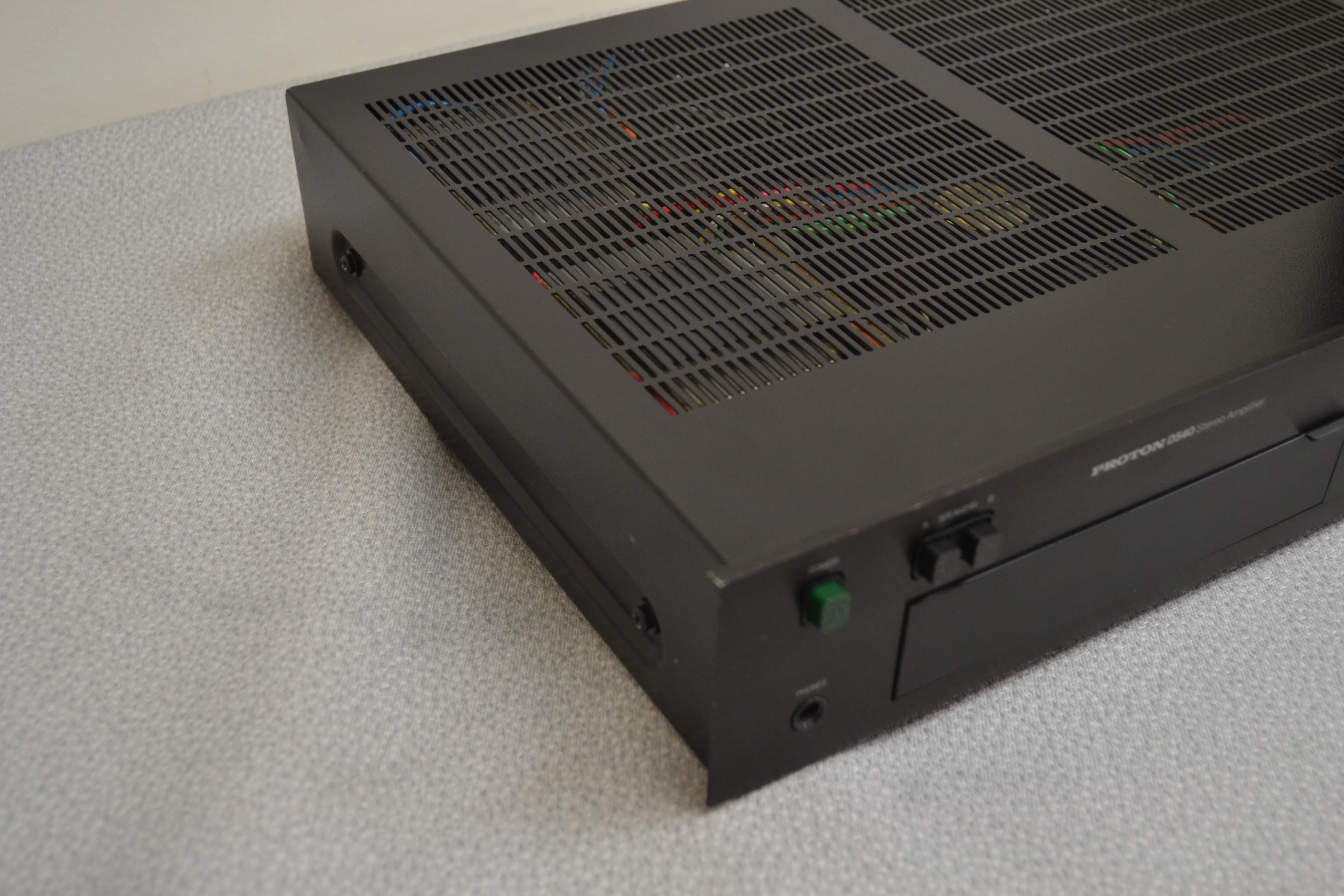
The Proton D540 is a compact but surprisingly heavy unit with a minimum of visible controls on its all-black exterior. Simple pushbuttons turn it on and off and select one or both sets of speaker outputs. Other than the small input-selector pushbuttons, the only visible operating control is the volume knob. The inputs provided are for phono, tuner, CD player (marked dad, for digital audio disc), and video; each button is duplicated to allow independent selection of sources for listening or tape recording. Similar buttons select playback from either of two tape decks or cross-connect them for dubbing from either machine to the other. There is a small yellow-green power-on pilot light and a red light that glows when the DPD power supply is being used.
Behind a hinged door on the front panel are small center-detented knobs for the bass and treble tone controls and the balance control, buttons for mono mode and loudness compensation, and a bass eq button that engages a low-frequency boost circuit to extend the low-frequency response of typical small woofers. The BASS EQ circuit has no effect above 100 Hz, but it boosts the response by almost 10 dB around 50 Hz while cutting the response by 18 dB per octave below 40 Hz.
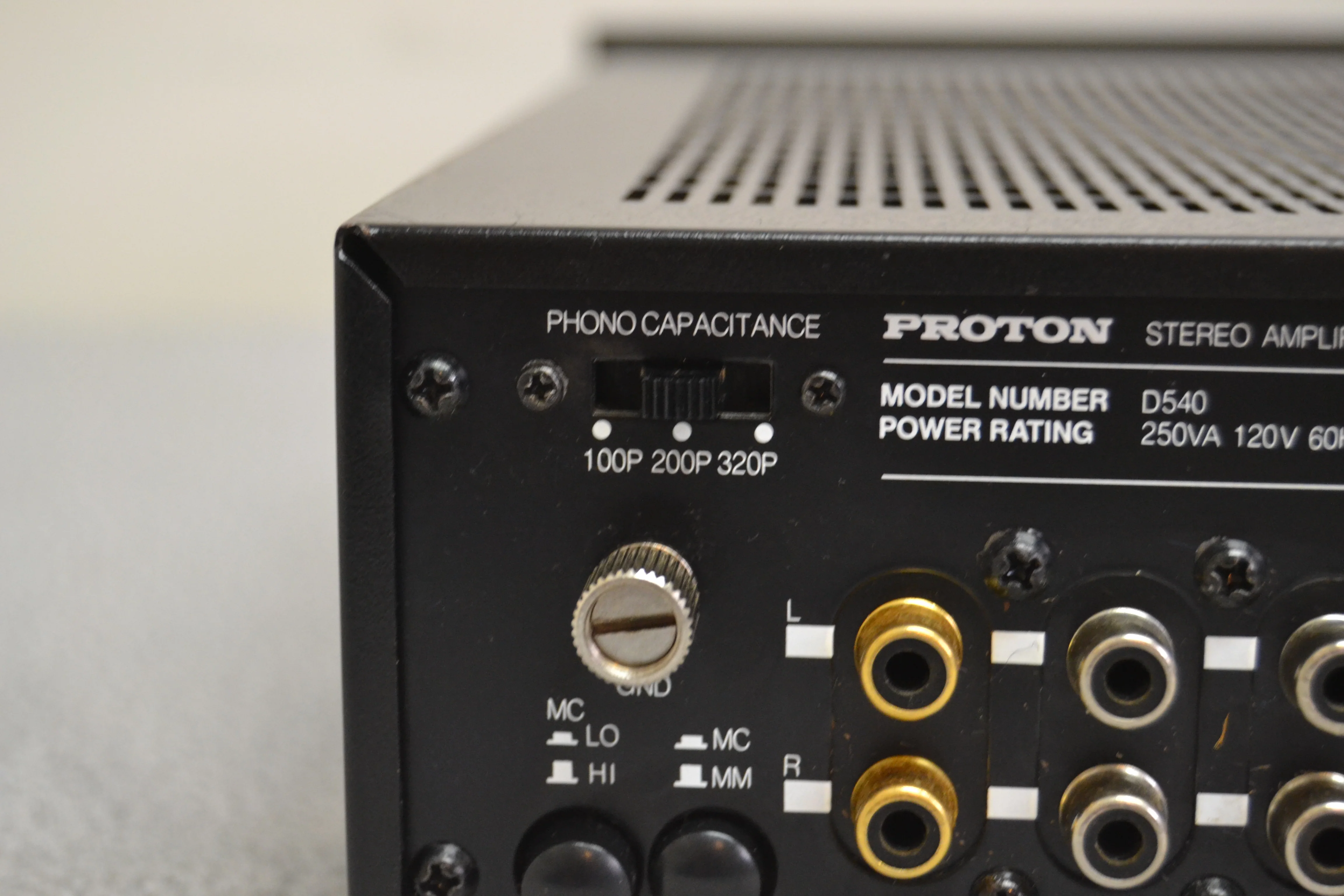
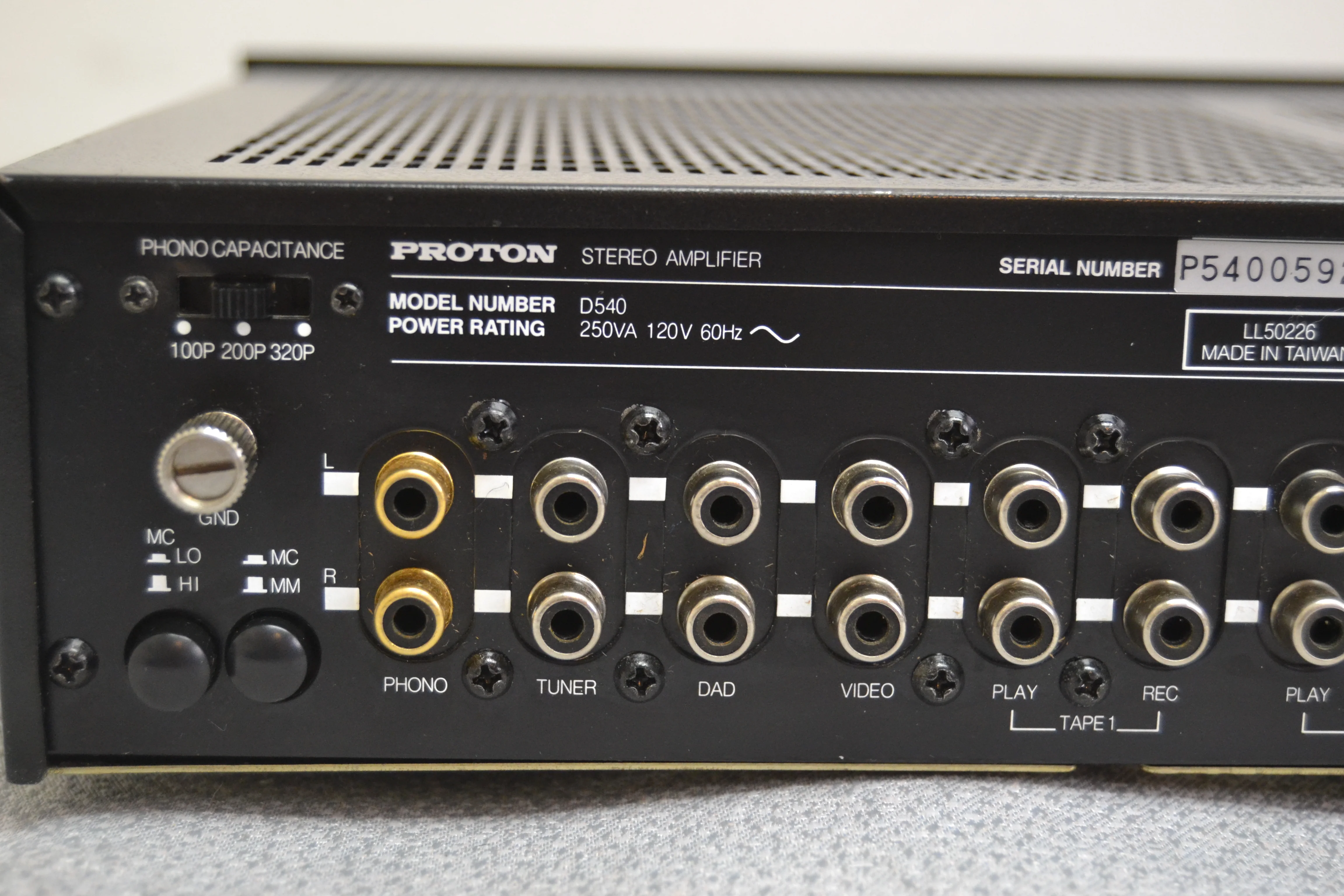
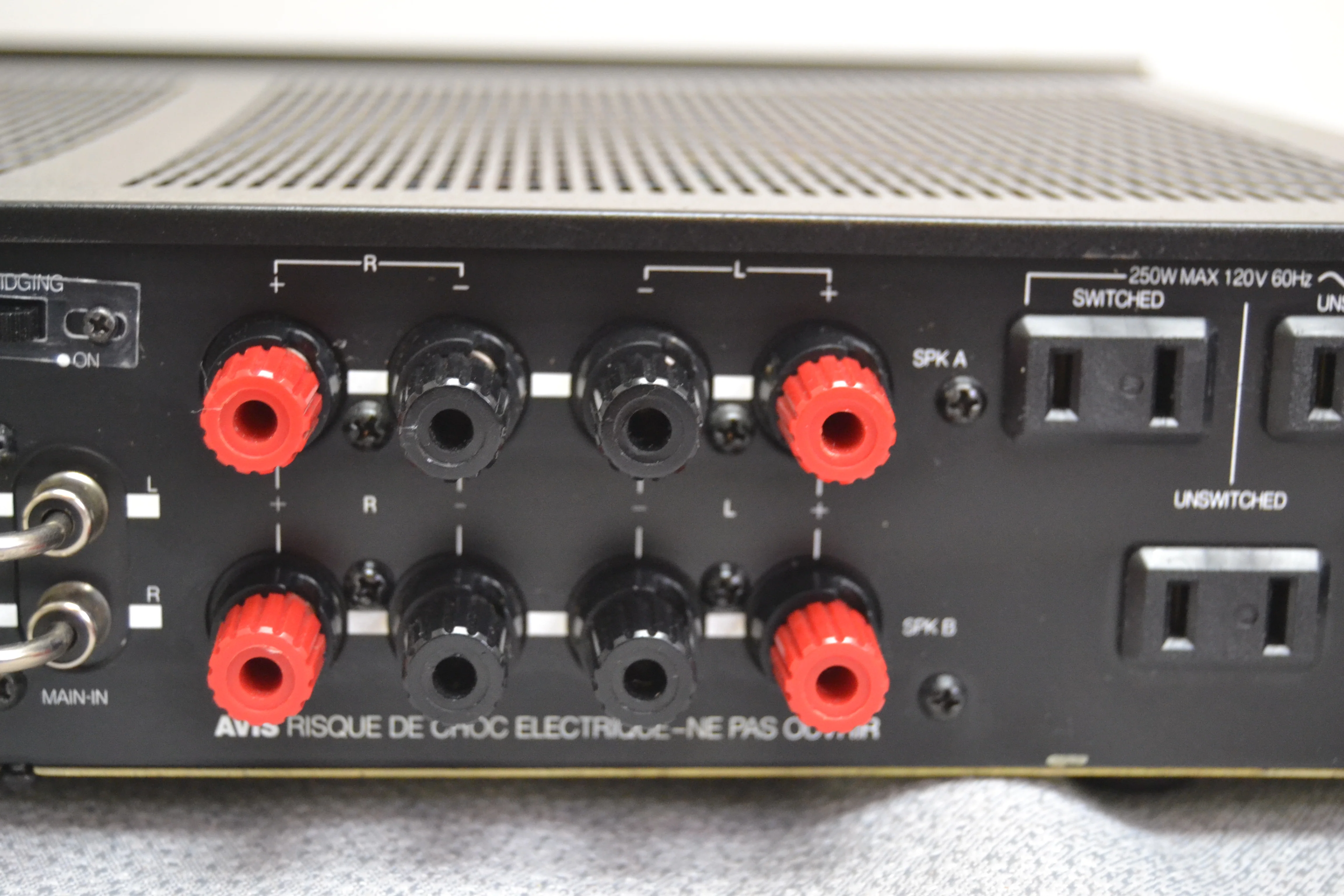
In addition to the various signal input and output jacks, the rear panel has pre-out and main-in jacks, normally joined by jumpers, for connecting external signal-processing accessories into the signal path. A pushbutton near the gold-plated phono jacks sets the preamplifier for input from either a moving-magnet or a moving-coil cartridge, and another button selects either high or low gain for the MC input. A three-position slide switch selects 100, 200, or 320 picofarads input capacitance for the MM input (across a 47,000-ohm resistance). Another slide switch engages Proton’s “anti-clipping” circuit, which smoothly rounds off the output waveform when the amplifier’s limits are exceeded rather than allowing hard clipping with its audibly unpleasant high-order harmonics. Another switch connects the two channels in a bridged mode, transforming the D540 into a mono amplifier with more than double its normal power. For stereo operation in the bridged mode, a second power amplifier can be driven from the D540’s pre-out jacks.
The Proton D540 is rated to deliver 40 watts into 8-ohm loads from 20 to 20,000 Hz with no more than 0.02 percent total harmonic distortion. Its dynamic power is variously rated from 150 to 380 watts for loads of 2, 4, and 8 ohms with durations from 20 to 200 milliseconds. The D540 is 16-1/2 inches wide, 12-5/8 inches deep, and 3-1/2 inches high and weighs just over 19 pounds. Price: $350.
Lab Tests
Preconditioning the Proton D540 for one hour at 13.3 watts (one-third rated power) made its top quite hot above the transistor heat sinks, but in normal use it never became more than moderately warm to the touch. With both channels driven at 1,000 Hz, the outputs clipped at 60 watts into 8 ohms, 90 watts into 4 ohms, and 128 watts into 2 ohms.
The 8-ohm harmonic distortion at 1,000 Hz fell from 0.006 to 0.002 percent as the power increased from 1 to 40 watts, rising to 0.0033 percent at 50 watts. The distortion curves were quite similar with 4-ohm and 2-ohm loads, with slightly higher readings and maximum power levels. In all cases the distortion was less than 0.01 percent from 1 watt to the clipping point. The reactive load factor was 2.3 dB. The amplifier was exceptionally stable with complex reactive simulated speaker loads, showing only a single cycle of overshoot on a 10,000-Hz square wave signal.
Across the audio range, at rated power or less, the distortion was typically 0.0025 to 0.005 percent, rising to 0.007 to 0.008 percent at 20 Hz and 0.01 to 0.016 percent at 20,000 Hz. At all times the distortion was well below the rated 0.02 percent.
Dynamic-power measurements dramatically demonstrated the effectiveness of the DPD system. The standard EIA dynamic-headroom measurement, with 8-ohm loads, produced a 20-millisecond output of 156 watts (for a headroom of 5.9 dB). With 4-ohm loads, the dynamic power was 288 watts, and into 2 ohms it was a prodigious 530 watts!
We also made dynamic-power measurements under the conditions specified by Proton for its amplifier ratings, using burst durations from 20 to 1,000 milliseconds and off times of 500 milliseconds, into loads of 2, 4, and 8 ohms and in the bridged mode with an 8-ohm load. The accompanying graph tells the story more vividly than mere words. With 4- and 8-ohm loads, the full 20-millisecond power level was maintained for 300 and 400 milliseconds, respectively, falling to the steady-state levels after a second or two. With 2-ohm loads, charge is drawn more rapidly from the high-voltage capacitors, and the maximum output dropped slightly during the first 100 milliseconds, followed by a smooth decline to continuous levels after about 2 seconds. In the bridged mode (8 ohms), the maximum output of almost 570 watts was maintained for 200 milli-seconds, and then the output dropped to 170 watts (the continuous value) after 1 second.
The D540’s tone controls had good characteristics and were capable of making subtle changes in the sound. The bass eq control boosted response 9.5 dB at 47 Hz and cut it by 12 dB at 20 Hz. The loudness compensation boosted both low and high frequencies to a moderate degree as the volume was reduced.
Comments
By any objective criteria, the Proton D540 is an exceptional amplifier. Its low noise and distortion levels, control flexibility, cool operation, and generally ideal performance by themselves rank it among the finest amplifiers we have seen. There are many good amplifiers on the market, however, and the special quality of the D540 really shows itself in the performance of its DPD system.
Listening to CD’s and other wide-range sources left no doubt of the remarkable qualities of this amplifier. It begs the issue merely to say that the D540 is by far the most powerful “40 watt” amplifier we have used (which it certainly is). More to the point, it is one of the few amplifiers of any rating we have seen whose capabilities begin to encompass the dynamic properties of live music. The peak-to-average ratio of music waveforms is often in the range of 10 to 20 dB, perhaps more (although of course every case is different). The Proton D540 has a ratio of 6 dB between its peak and its continuous maximum power levels, but the average power required, even for loud listening, is probably no more than a couple of watts. That gives the amplifier another 13 dB of dynamic range, for a total useful dynamic range of more than 20 dB. (Of course, I am not using “dynamic range” in its usual sense here. I am referring to the peak-to-average range of music rather than to the maximum sound level compared to the background noise in the hall.)
In practical terms, this means that with a CD or similar source and reasonably good speakers, the D540 brings us within earshot of the dynamic range of a live program. Please note that this is not the same as a realistic simulation of a live performance translated to your home; that is not within the capability of any amplifier or any other means now known to us. What the Proton D540 will give you is a degree of natural dynamics usually obtainable only with a few extremely powerful and expensive amplifiers. But with such amplifiers you have to pay for a huge continuous-power capability to reproduce high peak levels for fractions of a second at a time. The D540 gives you 99 percent of the same sonic impact at a fraction of the price.